What Avalanche Evergreen actually is
Avalanche Evergreen is not a single blockchain, nor is it a standalone token you can trade on an exchange. It is better understood as an institutional-grade framework for deploying and managing custom Layer 1 (L1) blockchains on the Avalanche network. Initiated by Ava Labs, the program provides the infrastructure, tooling, and compliance-ready configurations that allow enterprises to launch their own dedicated L1s without building the underlying consensus and networking layers from scratch.
The misconception that Evergreen is a specific coin often stems from how retail crypto markets operate, where every new initiative gets mapped to a tradeable asset. In reality, Evergreen is the backend strategy. It enables financial institutions, governments, and large enterprises to create isolated, high-performance networks that are interoperable with the broader Avalanche ecosystem but remain distinct in their governance, tokenomics, and compliance requirements.
This approach addresses the primary hesitation of institutional players: the fear of sharing public infrastructure with unpredictable retail traffic or incompatible regulatory environments. By using Evergreen, an organization gets a private or permissioned L1 that leverages Avalanche’s sub-second finality and high throughput, while maintaining full control over its specific operational parameters. The "Evergreen" name reflects the ongoing support and upgrade path provided by Ava Labs, ensuring these enterprise chains remain secure and functional over time.
The distinction matters for analysis because it shifts the value proposition from speculative token appreciation to utility and infrastructure adoption. When evaluating the Avalanche Evergreen analysis, you are looking at the growth of enterprise-grade L1 deployments rather than the price action of a single asset. The ecosystem’s strength lies in its ability to scale horizontally, allowing multiple independent L1s to exist simultaneously, each serving a specific institutional need.
For a visual representation of the broader market context that influences these institutional decisions, the chart below shows the current performance of the native Avalanche token, which serves as the economic backbone for these Evergreen deployments.
Why enterprises are choosing sovereign subnets
The shift from public chains to sovereign subnets is driven by a fundamental mismatch: public blockchains offer decentralization, but enterprises need control. For high-stakes financial institutions, the public ledger is often too opaque, too slow, and too rigid for regulatory compliance. Sovereign subnets solve this by allowing organizations to spin up custom blockchains with the specific features they require, rather than adapting their operations to fit a generic protocol.
Compliance and Regulatory Clarity
Public chains struggle with identity verification and data privacy regulations like GDPR or HIPAA. A sovereign subnet allows an institution to embed identity layers directly into the consensus mechanism. This means only verified participants can transact, and data can be kept private or restricted to authorized nodes. This structural compliance is far more robust than attempting to layer privacy solutions on top of a public network.
Performance Isolation
In a public environment, transaction fees spike and latency increases during network congestion. For trading platforms or settlement layers, this unpredictability is unacceptable. Sovereign subnets provide performance isolation, ensuring that the subnet’s throughput is dedicated solely to the institution’s needs. This guarantees predictable latency and consistent execution speeds, which are critical for real-time financial operations.
Customizable Governance
Public chains require broad community consensus for upgrades, a process that can be slow and politically fraught. Sovereign subnets allow institutions to define their own governance rules. This means changes to the protocol, tokenomics, or security parameters can be implemented quickly and efficiently, aligning the blockchain’s evolution with the institution’s strategic goals.
Spruce testnet and privacy features
The Spruce testnet represents the current frontier for Avalanche Evergreen, moving beyond theoretical compliance into practical, institutional-grade deployment. This environment allows developers to stress-test the specific privacy-preserving token formats and selective visibility mechanisms that define the Evergreen strategy. By simulating real-world institutional constraints, Spruce demonstrates how subnets can satisfy strict regulatory requirements without sacrificing the efficiency of public blockchain infrastructure.
At the core of this architecture is a privacy-preserving token format that enables selective visibility. This mechanism ensures that while some actors, such as auditors or regulators, maintain full transparency into transaction histories and holdings, other participants see only what is necessary for the network to function. This granular control is essential for high-stakes financial analysis, where data sensitivity often conflicts with the need for verifiable audit trails. It effectively creates a "glass box" for compliance officers while maintaining a "black box" for competitors and general market participants.
The integration of these features into subnets addresses the primary hesitation institutions face when adopting blockchain technology: the fear of exposing proprietary financial data. By allowing custom token standards that enforce these visibility rules natively, Avalanche Evergreen offers a solution that aligns with existing compliance frameworks rather than forcing organizations to adapt to opaque or overly public systems.
To understand how these institutional subnets perform under live market conditions, it is useful to observe the broader asset context. The following technical chart for AVAX provides a baseline for network activity and sentiment, which often correlates with the adoption of new Evergreen capabilities.
Comparing Evergreen L1 deployment options
Avalanche Evergreen L1s are not one-size-fits-all. The platform offers a suite of blockchain deployments and tooling designed to address company-specific and industry-wide considerations. Understanding the differences between configurations helps institutions choose the right stack for their specific regulatory and performance needs.
The following comparison outlines how different Evergreen L1 options vary in compliance, performance, and target sectors. This structure highlights the flexibility of the Avalanche stack for high-stakes financial analysis and enterprise applications.
| Feature | Financial Services L1 | General Enterprise L1 |
|---|---|---|
| Compliance | Built-in KYC/AML at protocol level | Standard access control lists |
| Performance | Sub-second finality, high TPS | Balanced throughput for general apps |
| Target Industry | Banks, asset managers, exchanges | Supply chain, healthcare, IoT |
| Customization | Deeply customized for regulatory reporting | Flexible for diverse business logic |
Financial Services L1s are engineered for strict regulatory environments. They often include built-in compliance features like KYC/AML checks at the protocol level, ensuring that only verified participants can interact with the chain. This is critical for institutions handling sensitive financial data.
In contrast, General Enterprise L1s prioritize flexibility and broad applicability. They offer standard access control and balanced performance, making them suitable for supply chain management, healthcare records, or IoT applications where strict financial regulation is not the primary concern.
Both options leverage the underlying Avalanche consensus for security and speed. The choice depends on whether your primary constraint is regulatory compliance or operational versatility. For real-time market context, you can monitor the performance of the underlying AVAX asset:
Community sentiment and case studies
The Avalanche Evergreen analysis reveals that institutional adoption is driven by the need for sovereign control without sacrificing interoperability. Reflexivity Research highlights how projects use subnet technology to spin up sovereign blockchain networks, ensuring performance isolation for high-throughput applications. This technical flexibility is the primary draw for enterprise clients seeking dedicated infrastructure.
Developer feedback on Reddit reinforces this trend. Users in r/Avax frequently discuss the practical benefits of running custom subnets, noting that the ability to tailor consensus and virtual machines to specific regulatory or performance needs is a game-changer. The community sentiment shifts from theoretical interest to tangible deployment as more projects realize the efficiency gains of dedicated chains.
Strategic checklist for adoption
Before deploying an Evergreen L1, enterprises must validate the technical and regulatory fit. This checklist summarizes the critical decision points for evaluating Avalanche's institutional subnet strategy.
Ensure the subnet architecture supports your specific regulatory needs. Evergreen offers customizable privacy features, such as selective visibility for auditors, which is essential for financial institutions operating under strict data governance rules.
Evaluate whether sovereign performance isolation is required. Dedicated L1s prevent network congestion from affecting your transactions, ensuring consistent latency and throughput for high-stakes operations.
Compare the infrastructure costs of running a custom subnet against shared network resources. Factor in the development overhead for customizing the virtual machine and the ongoing operational expenses for validator nodes.
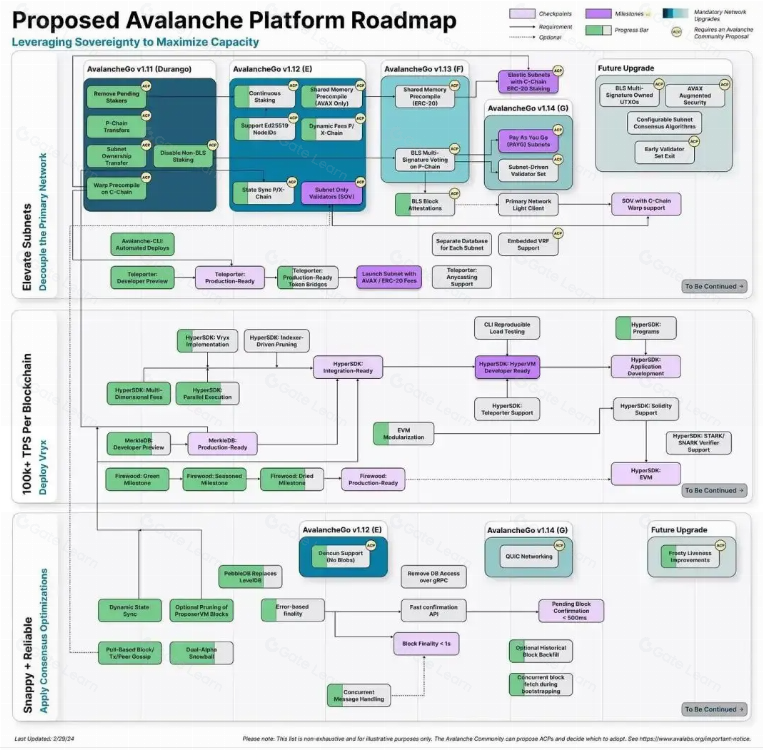
Use the Spruce testnet to prototype your deployment. This environment allows you to validate your smart contracts and subnet configurations before committing to mainnet resources, reducing risk and development time.
Avalanche Evergreen analysis suggests that this approach offers a balanced path for institutions seeking both sovereignty and interoperability. By following these steps, you can ensure a smooth transition to a dedicated blockchain infrastructure.
No comments yet. Be the first to share your thoughts!